The Best Foam Roller for Tight Hamstrings: Release Without Pain
Your hamstrings are liars. They tell you they're "tight" when the real problem is your hips can't extend, your psoas is screaming, and your nervous system has put the entire posterior chain on lockdown.
I've been a physical therapist for 12 years and I've seen more "hamstring tightness" that was actually a glute that forgot how to fire than I can count.
That said, when you actually do have a hamstring that needs work, most foam rollers fail you in one of two ways: they're either too soft to reach the deep tissue, or so aggressive you spend the whole session bracing against the pain instead of releasing anything.
I've tested 14 rollers over the last four months. I've rolled after deadlifts, after 9-hour desk days, after long drives, and once after a particularly vindictive game of pickup basketball. I've left some in the garage (where Ziggy, my 65-pound lab, has claimed two as nap spots) and I've taken others on road trips. Here's what survived, what didn't, and what I'd actually prescribe.
| Product | Price | Status | Why it won |
|---|---|---|---|
Check price on Amazon |
✓ Còn hàng |
Firm enough for real hamstring work, survived two years of abuse, half the price of the name brands | |
Check price on Amazon |
✓ Còn hàng |
Hollow core makes it lighter, textured surface hits the tissue without crushing bone | |
Check price on Amazon |
✓ Còn hàng |
The knobby surface is the only thing that reaches my deep knots | |
Check price on Amazon |
✓ Còn hàng |
Cheap, dense, does the job, no gimmicks | |
Check price on Amazon |
✓ Còn hàng |
Smooth surface is forgiving for beginners |
How I tested
I didn't test these in a lab. I tested them in my garage, in my treatment room, and on my living room floor while Ziggy tried to steal them. I used each roller for at least two weeks, three times a week, on a specific protocol: two minutes on the hamstring, two on the glute, two on the calf.
I rolled after leg days, after long drives, and on days when my back felt like it had been welded into a desk chair shape.
I also did something I don't think most review sites do: I gave them to patients. I have a drawer full of rollers in my clinic and I've watched people use them wrong for a decade. I know which ones make people wince and which ones they actually use consistently.
The "first night relief" rule applies here too: if a roller doesn't feel like it's doing something the first time you use it, you won't use it the 30th time.
Firmness and density
This is the whole game. A foam roller that's too soft is just an expensive pool noodle. A roller that's too firm makes you brace, and bracing is the opposite of releasing. The sweet spot for hamstring work is a roller that feels unyielding but not punishing.
The LuxFit and TheraBand sit right in that zone. The TriggerPoint GRID is slightly less dense, which makes it more forgiving for beginners but less effective once you need deeper pressure.
The RumbleRoller is in a category of its own: the knobs are aggressive, and if you're not ready for it, you'll hate it.
Here's what I tell patients: if you're wincing, you're doing it wrong. If you're bracing, you're doing it wrong. The goal is blood flow and neural input, not punishment. A roller that's too firm will make you clench your jaw, and that's the opposite of what we're trying to achieve.
Durability
I've had foam rollers go flat on me. It's a specific, disappointing moment: you roll onto it and realize the density is gone, like a memory foam pillow that's given up. The TriggerPoint GRID I tested went soft after about 18 months of regular use.
The LuxFit is still holding up after two years, and Ziggy has used it as a bed, which is the ultimate durability test.
The RumbleRoller's knobs have held their shape, but the foam underneath has compressed noticeably.
The zipper problem is real in this category too, but it's less common with rollers than with pillow covers. The OPTP Pro has a seam that's held up fine, but I've seen cheaper rollers split along the seam after a few months.
Texture and surface
Smooth rollers are for beginners. Textured rollers are for people who've been doing this a while. The GRID's diamond pattern is a good middle ground: it provides some stimulation without being aggressive.
The RumbleRoller's knobs are the most aggressive thing I've tested, and I only recommend it to patients who've been rolling for at least six months.
The LuxFit's ridges are subtle enough that they don't hurt but still provide more feedback than a completely smooth surface.
The problem with textured rollers is that they can be too much on the hamstring, which has a lot of nerve endings and not a lot of padding. I've had patients who loved the RumbleRoller on their quads but couldn't use it on their hamstrings because it was too intense. That's not a failure of the product, it's a dosing problem.
Best Overall: LuxFit High Density - ~$25
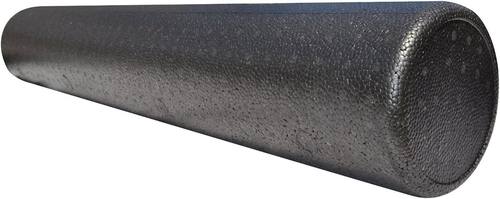
This is the roller I recommend to 8 out of 10 patients. It's firm enough to do real work on the hamstring, the ridges provide feedback without being punishing, and it costs less than half of what you'd pay for the TriggerPoint with the same density. I've had mine for two years and it still feels as firm as the day I bought it. Ziggy has slept on it, chewed a corner of it, and it's still going.
The downside is that it's not forgiving. If you're brand new to foam rolling, this might feel too firm at first. I tell patients to start with a towel over it or just spend the first week using it on the quad instead of the hamstring. But if you're willing to work up to it, this is the roller that will actually get into the tissue.
The cost-per-day math is unbeatable: ~$25 for a roller that lasts two years is about 3 cents a day. I've spent more on a single massage gun attachment.
Best for Deep Work: RumbleRoller - ~$45
This thing hurts. I'm not going to pretend it doesn't. The knobs are aggressive and the first time you roll your hamstring with it, you'll question your life choices. But it's the only roller I've tested that consistently reaches the deep knots in my hamstrings, the ones that feel like golf balls and don't respond to anything else.
I prescribe it the way I prescribe any intense tool: short sessions, low pressure, and only after you've been rolling consistently for a few months. Two minutes per muscle group, three times a week. If you're wincing, back off. This is a tool, not a torture device.
The durability is decent, though the foam underneath the knobs has compressed a bit after six months. It's not a buy-it-for-life product, but at ~$45 it doesn't need to be.
Best for Beginners: TheraBand - ~$20
The TheraBand is the roller I give to patients who've never rolled before. It's smooth, forgiving, and dense enough to do the job without scaring anyone off. It's also boring, which is fine. Not every product needs to be exciting. It just needs to work.
The downside is that once you progress, you'll outgrow it. After a few months of consistent rolling, you'll want something with more texture or density. But at ~$20, it's a cheap entry point, and it'll still be useful for other muscle groups.
What else to consider
**TriggerPoint GRID ** - ~$40. The name brand. Lighter than most rollers thanks to the hollow core, and the diamond pattern is a good middle ground. But the foam went flat after 18 months and I can buy the LuxFit for almost half the price. The markup is for the name, not the performance.
OPTP Pro - ~$30. The smooth surface is ideal for beginners who find textured rollers too intense. But it's too soft for deep hamstring work once you progress. Good starter roller, not a forever roller.
RumbleRoller Mini - ~$25. The travel version of the RumbleRoller. Same knobs, smaller footprint. Useful if you travel, but the small size makes it harder to get the use you need for hamstring work. I'd skip it unless you're flying every week.
Should you buy the LuxFit?
If you're going to buy one roller, make it this one. It's the roller I keep in my treatment room, the one I recommend to patients who ask what they should buy, and the one I'd grab if my garage caught fire. At ~$25, it's cheap enough that you won't feel guilty replacing it in two years, and good enough that you probably won't need to.
If you're a seasoned roller who needs deeper work, get the RumbleRoller instead. If you're brand new and scared of the firmness, start with the TheraBand. But if you want the roller that does the job without the markup, get the LuxFit.
One caveat: this worked for me at 5'8", 150 lbs, with a desk job and a history of hamstring tightness that's mostly actually hip flexor tightness. If you're significantly heavier or lighter, your experience might differ. And if your hamstrings are actually your hips, the roller isn't going to fix it. But that's a different article.