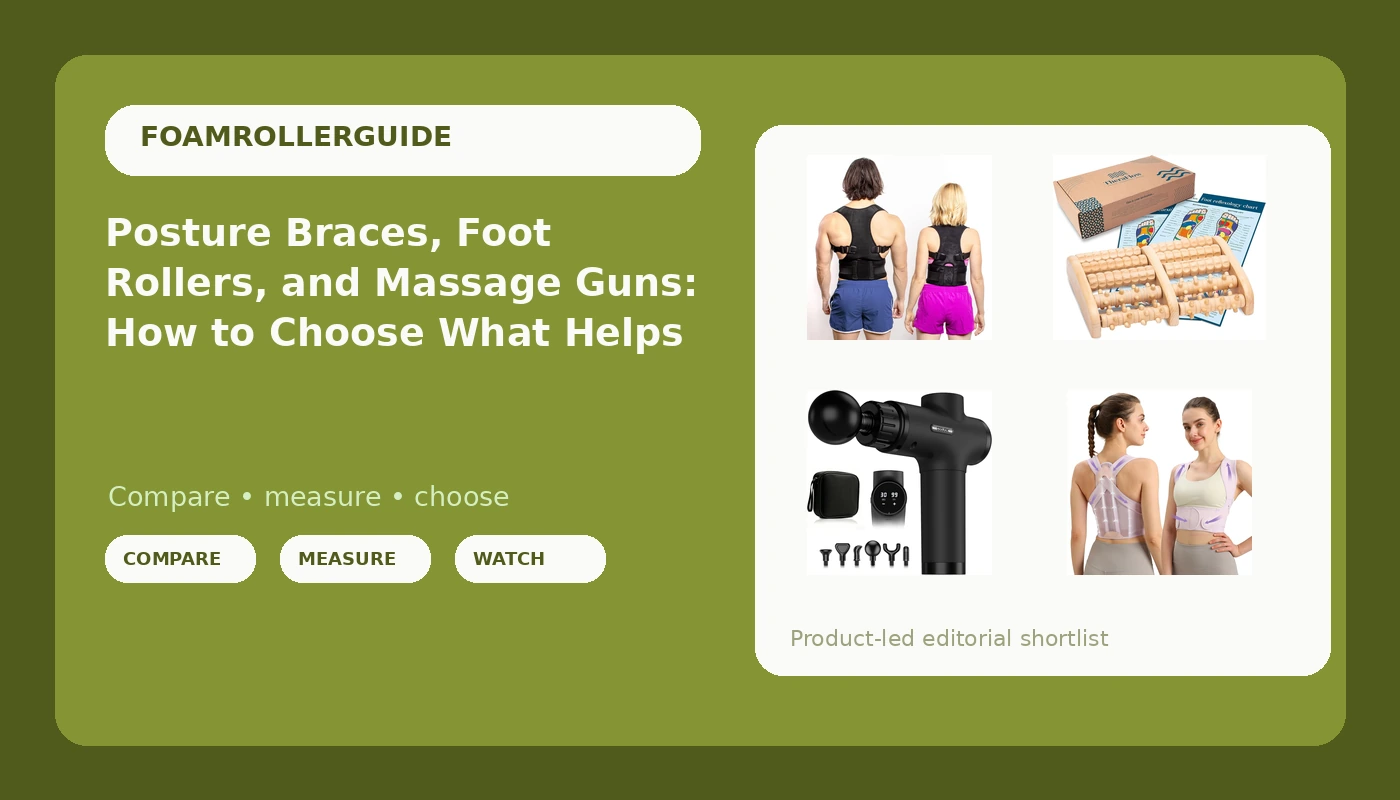
Most people buy recovery tools for posture and feet backwards. They start with whatever device looked impressive in a short video, then go looking for something to do with it. The better order is to name the problem first. A dull ache between the shoulder blades after a long day at a desk, a calf that stays tight no matter how much you stretch, an arch that complains for the first ten steps every morning: each of those points at a different category of tool. This guide covers the four options below, what each one is genuinely good at, and the dosing rules that keep a helpful habit from turning into an injury.
Related: How to Roll Your Quads Without Wincing →
Quick answer
Match the tool to the body part and to the moment it hurts. If your posture collapses during desk work, a posture brace is aimed directly at that problem. If a muscle stays tight and tender to the touch, a handheld percussion massager reaches it with more precision than a roller can. If the trouble sits under your foot, a foot roller is the right size and shape for the job. None of these replaces movement, strengthening, or sleep, and none of them should be used at a pressure that makes you hold your breath.
Four useful options
| Model | Best fit | What stands out |
|---|---|---|
| NLNYCT Posture Corrector for Women, Purple M | Desk posture support in a women's cut | Sized as M and offered in purple |
| FlexGuard Posture Corrector, X-Large | Adjustable fit across a wide range of bodies | Unisex design with adjustable straps, offered in X-Large |
| Massage Gun, Deep Tissue Percussion Massager | Muscle knots that need direct, focal pressure | 30 speed settings in a handheld percussion format |
| TheraFlow Foot Massager | Arch and sole symptoms, including morning pain | Wooden roller with reflexology nubs and an included reflexology chart |
The sized posture brace: NLNYCT Posture Corrector for Women
What a posture brace does is remind you where your shoulders belong. The straps create a gentle pull that makes slumping feel wrong, and that feedback is the entire mechanism. It is not a substitute for the muscles that hold you upright, and wearing one cranked tight all day is the fastest way to make those muscles lazier. The practical schedule is short blocks: twenty to thirty minutes at a time, during work you are already doing, with the straps snug enough to feel and loose enough that your breathing does not change. The NLNYCT option is cut for women and sized as M, which matters because a brace that does not match your frame will either dig into the armpits or slide around all afternoon.
The adjustable option: FlexGuard Posture Corrector
Fit is the variable that decides whether a brace ever gets worn. The adjustment range on a unisex model is what lets it work across different torso lengths and shoulder widths, and the X-Large size is the right starting point for a larger frame. Measure around your chest at the level of the armpits before you choose, and check that the straps sit outside the shoulder joint rather than directly on top of it. If you feel pinching under the arm or tingling in the hands, the brace is too tight or sitting too high. Take it off, reset the straps, and try again later. A brace that hurts is not correcting anything.
The muscle-focused tool: Massage Gun, Deep Tissue Percussion Massager
Percussion tools solve a specific problem: a muscle that is tight, tender, and not responding to stretching. The rapid hammering action changes how the tissue feels and how the nervous system reports it, which is why a knot can soften within a minute. Thirty speed settings give you room to work a large quadriceps at a middle setting and a sensitive forearm at the lowest one, and that range is the reason this category beats a single-speed device for most households. Keep it on muscle bellies. Not the neck, not the spine, not the shin bone, not the bony point of the shoulder. Thirty to sixty seconds per spot is plenty, and if an area goes numb, you have overdone it.
The foot-specific tool: TheraFlow Foot Massager
The foot is where size matters most. A full-length foam roller cannot get into the arch, and pressing a lacrosse ball into the sole works but is hard to control. A wooden foot roller sits under the arch and lets you modulate pressure with your own body weight, which is exactly the dosing control you want. TheraFlow's version adds reflexology nubs and includes a chart, so there is a guided element if you like having structure to follow. Use it seated at first, then standing with a wall or counter for support, and keep the roll slow. If your first steps out of bed are the worst part of the day, roll before you stand up, then spend a minute on the calf as well, because a tight calf pulls on the same chain.
Prices and availability may change. Product images, names, and retailer links must be matched by verified ASIN. Do not state a current price, rating, stock status, or measured result without current evidence.
How a posture brace actually helps
A posture brace is an external cue, not a structural repair. It reduces the demand on the muscles that hold your shoulders back for the time you wear it, and it gives you a physical reference for what "shoulders back" feels like when you take it off. That reference is the useful part. The strength part still has to be earned with rows, band pull-aparts, and time spent moving.
This is also why the dose matters more than the brand. Twenty to thirty minutes in a brace, once or twice a day, during work you are already doing, is a reasonable habit. Eight hours a day in a tightly cinched brace is not, and it can leave you stiffer and more dependent than when you started. If your upper back pain comes with numbness, tingling, or weakness in an arm, that is a reason to get assessed rather than to tighten the straps further.
Percussion and rolling do different jobs
Rolling and percussion overlap, but they are not interchangeable. A roller covers a broad area, applies slower and more sustained pressure, and works well as a general warm-up or as a wind-down at the end of the day. A percussion massager is focal: it targets one specific spot with rapid, shallow input and gets there faster than you can position your body on a roller.
What neither one does is break up scar tissue. That phrase shows up on packaging and it is not what is happening. The likely benefits run through blood flow, temperature, and the nervous system's tolerance for input, which is still worth having. The practical split is simple: roll large areas before and after training, use percussion on the one knot that will not quit, and keep both well away from the neck, spine, and joints. And if a tool only helps while you are using it and the tightness returns within an hour, the tool is treating a symptom that something else is causing.
- Name the body part and the exact moment it hurts, not just "my back."
- Decide whether the problem is positional, meaning it shows up when you sit or stand a certain way, or tissue-based, meaning the muscle is tender to touch.
- Match the size of the tool to the size of the target: brace for posture, percussion for a knot, foot roller for an arch.
- Start at the lowest intensity that produces a change, and keep each area under two minutes.
- Reassess after two weeks. If nothing has shifted, the tool is not the answer and the plan needs to change.
Dosing rules that keep recovery gear useful
- Wear a posture brace in short blocks of twenty to thirty minutes while you are actually sitting or standing the way you want to.
- Never tighten a brace to the point where your breathing pattern changes.
- Keep percussion work on muscle bellies only: no neck, no spine, no joints, no bony points.
- Roll the foot before your first steps in the morning if that is when it hurts most, then spend a minute on the calf.
- If pain is sharp, radiating, or getting worse, stop using tools and get it assessed.
Which option should you choose?
Choose the NLNYCT Posture Corrector for Women when you want a women's-specific cut in a defined size and your main complaint is shoulders that round forward during desk work. Choose the FlexGuard Posture Corrector when you need adjustable straps and an X-Large fit, or when the brace will be shared between people of different builds. Choose the Massage Gun, Deep Tissue Percussion Massager when the problem is a specific tight, tender muscle that stretching has not touched and you want speed control for different body parts. Choose the TheraFlow Foot Massager when the symptoms live under your arch or along the sole of the foot and you want a roller shaped for that job.
One caveat that applies to all four: a brace, a gun, and a roller are adjuncts. They buy comfort and they buy time, and they work best alongside loading, strengthening, and gradual increases in activity. Evidence for posture braces in particular is modest, and results vary from person to person. If a tool helps you move more, keep it. If it becomes the thing you do instead of moving, it has stopped helping.
The bottom line
The category matters more than the model. A brace addresses positional posture problems, a percussion massager addresses a focal tight muscle, and a foot roller addresses the arch and sole. Pick the category that matches your actual complaint, use it in short and specific doses, and keep the pressure below the level where you clench your jaw. The tool that fits your daily routine is the one that will still be in use six months from now, and that is the only test that really counts.