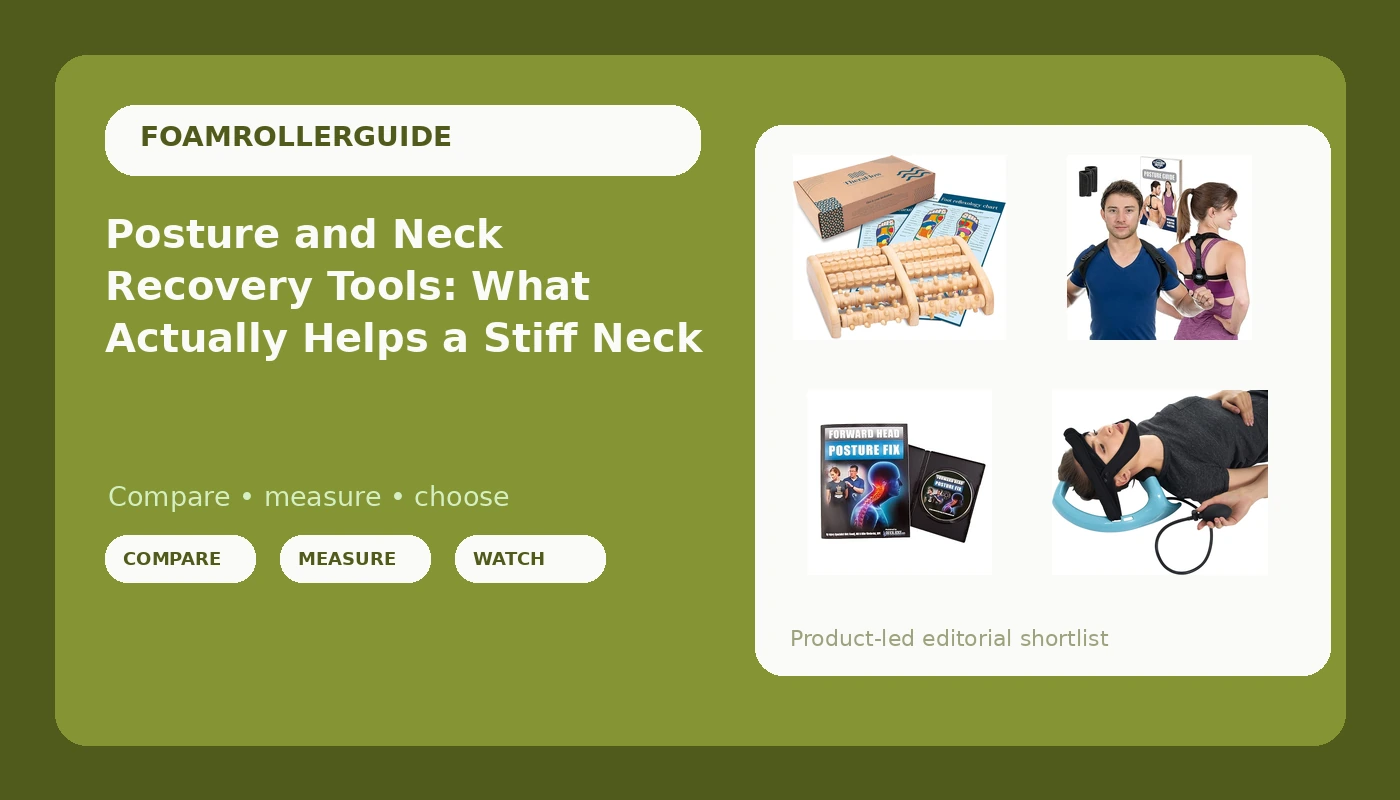
Neck stiffness and rounded shoulders rarely arrive all at once. They accumulate, one long desk day at a time, until checking a blind spot while driving feels like a project and your upper back aches by mid-afternoon. The usual response is to buy something: a brace, a pump, a roller, a program. The tool is rarely the problem. The problem is that people buy the wrong category of tool for the thing that actually hurts, then blame themselves when it does not work. Posture and neck recovery tools fall into four fairly distinct jobs: reminding you to hold a better position, applying gentle traction to the neck, teaching muscles to do the work themselves, and easing the tissue that supports everything above it. Knowing which job you need is most of the decision.
Related: Foam Rolling for Neck and Shoulders Without Making It Worse →
Quick answer
These four products do four different jobs, and none of them replaces the others. A posture brace is a reminder that helps you notice a collapsed position during desk work. A cervical pump applies gentle, controllable traction to the neck. A structured exercise program teaches the muscles around the neck and upper back to hold a better position on their own. A wooden foot roller works the plantar surface and the tissue along the arch. Pick the one that matches your main complaint, give it several weeks of consistent use, and treat anything that produces numbness, tingling, or radiating pain as a reason to get evaluated rather than a reason to push harder.
4 useful options
| Model | Best fit | What stands out |
|---|---|---|
| Posture Corrector for Women and Men | Desk workers who lose track of their posture | Adjustable upper back and shoulder straps in Medium/Large sizing |
| Posture Neck Exercising Cervical Spine Hydrator Pump | Stiff necks that feel compressed | Pump-driven support that cradles the curve of the neck |
| Exercises For Injuries Forward Head Posture Fix | People ready to do the active work | Structured trigger point and strengthening sequence for forward head posture |
| TheraFlow Foot Massager for Plantar Fasciitis Relief | Tired arches and time on your feet | Wooden roller with textured nubs and an included reflexology chart |
Desk posture cue: Posture Corrector for Women and Men
A brace like this one is an external cue. It does not strengthen anything by itself, and it does not change the shape of your spine. What it does is make a collapsed position noticeable: when the straps pull, you sit up. That feedback is genuinely useful for people who lose track of their posture during a long workday, because the first step in changing any habit is noticing it.
The trap is wearing it from morning to night. If the brace is holding you up, your own postural muscles get to coast, and the position it enforces disappears the moment you take it off. A more useful pattern is a defined block of time, an hour or two during your heaviest desk work, paired with movement breaks and the strengthening work described further down this page. The adjustable straps and Medium/Large sizing make it straightforward to dial in, but your schedule with it matters more than the fit.
Neck traction: Posture Neck Exercising Cervical Spine Hydrator Pump
Neck traction works on a simple principle: a sustained, gentle pull can reduce the sense of compression that builds in a stiff neck, and the relief often lasts longer than the session itself. A pump design lets you control that pull rather than guessing at it, inflating the support under the curve of your neck until the pressure feels like a slow stretch rather than a crank.
Dose matters more here than with almost any other tool on this page. Start with a small amount of air, keep the session to a few minutes, and stop immediately if you feel tingling, numbness, dizziness, or pain running into the arm or hand. Those are signs to get evaluated, not signs to push through. Used mildly and briefly, this is one of the more approachable ways to give a stiff neck a few minutes of supported rest.
The active work: Exercises For Injuries Forward Head Posture Fix
Here is the uncomfortable part: everything else on this page is support, and this is the part that asks something of you. A brace cues a position, traction gives the neck a rest, and a foot roller eases tissue, but none of those teach your body to hold a better position when you stand up and walk away from them.
Forward head posture is a load problem. The muscles at the front of the neck and between the shoulder blades have to be strong enough and coordinated enough to keep the head stacked over the shoulders, and that capacity comes from repeated, progressive work. A structured program helps because it removes the guesswork about which exercises, in what order, and for how long. Trigger point work eases tissue that is guarding; strengthening builds the capacity to hold. The catch is consistency. Three weeks of short daily sessions will do more than one ambitious weekend.
The base of the chain: TheraFlow Foot Massager for Plantar Fasciitis Relief
Feet are not usually what people think of when they hear the word posture, but they are the base of the chain. The plantar surface takes thousands of steps of load a day, and the tissue along the arch and heel responds to that load the way other tissue does: it tightens, it gets tender, and it benefits from some deliberate attention.
A wooden roller like this one is a straightforward tool for that job. You sit, put the arch over the roller, and move slowly back and forth with as much body weight as feels tolerable. The nubs give you something to work around, and the included reflexology chart is a starting reference rather than a treatment plan. Roll for a minute or two per foot, keep the pressure at uncomfortable rather than painful, and use it around time on your feet rather than as a substitute for footwear that fits and a training load your feet can actually handle.
Prices and availability may change. Product images, names, and retailer links must be matched by verified ASIN. Do not state a current price, rating, stock status, or measured result without current evidence.
What these tools actually do
The popular explanation is that rolling breaks up scar tissue and lengthens muscle. The more accurate and more useful explanation is quieter. Mechanical pressure and movement change blood flow, tissue temperature, and the nervous system's sense of how much tension is safe to hold. That is why an area often feels looser afterward even though nothing structural changed. Traction follows the same logic: it creates a temporary change in load and sensation, not a permanent realignment of the spine.
Braces work on feedback. They give your brain a reference point for "upright" that it may have stopped registering after years of hunching over a laptop. That is a real benefit, and it is also a limited one, because the cue only exists while you wear it.
Exercise works on capacity. It is slower than any of the passive tools and it is the only one that changes what your body can do without help.
Foot rolling works on tissue under load. It does not fix footwear, training volume, or the way you stand, but it can make the bottom of the foot feel less guarded.
None of these tools fixes posture permanently. Posture is a habit plus a load tolerance, not a shape you buy once.
How to match a tool to your complaint
- Name the specific problem in one sentence. "My neck is stiff when I wake up" points somewhere different from "I slouch by 3 p.m. every day."
- Decide whether you need a cue, a stretch, or capacity. A cue is the brace. Relief is the cervical pump or the foot roller. Capacity is the exercise program.
- Set the dose before you buy anything. Two minutes per area, pressure that is uncomfortable but not painful, sessions short enough that you will actually repeat them.
- Match the tool to the time you really have. If a twenty-minute routine will not survive your week, choose the two-minute option and do it daily.
- Reassess after three to four weeks. If nothing has changed, the tool is probably not the issue, and it is worth having a clinician look at what is driving the symptoms.
Practical rules that keep you out of trouble
- Never let a brace become your posture. Take it off for movement breaks, and treat it as a reminder rather than a support structure.
- Keep neck traction sessions short and mild. Stop at tingling, numbness, dizziness, or pain that travels into the arm.
- Roll the foot seated before you try it standing. Standing adds body weight fast, and the arch does not need that much pressure to respond.
- Roll before a workout to prepare, and after a workout to settle down. Those are different jobs and different pressures.
- Sharp pain, night pain, or weakness in the arm or hand is a reason to see a clinician, not a reason to buy another tool.
- A tool that lives in a drawer is not helping. Buy the one that fits your actual routine, not the routine you wish you had.
Which option should you choose?
Choose the Posture Corrector for Women and Men when your main problem is losing track of your position during long desk days and you want a physical reminder to reset. Choose the Posture Neck Exercising Cervical Spine Hydrator Pump when your neck feels compressed and stiff and you want a few minutes of gentle, controllable traction. Choose the Exercises For Injuries Forward Head Posture Fix when you are ready to do the active work, because that is the only option here that builds capacity rather than providing temporary relief. Choose the TheraFlow Foot Massager for Plantar Fasciitis Relief when tired arches and plantar surface tension are part of your picture, or when you want a low-effort tool you can use while watching television.
If you can only pick one and your goal is a durable change, the exercise program is the one with the longest runway. If your goal is comfort today, the traction pump and the foot roller are the more immediate options. Combining a passive tool with the active program is reasonable; combining three passive tools and no exercise is not.
This article describes how these categories of tool are generally used. It is not a diagnosis, and it does not account for your specific history, imaging, or symptoms.
The bottom line
Posture and neck recovery tools are not interchangeable, and the marketing around them tends to blur four separate jobs into one vague promise. A brace gives you feedback while you wear it. A cervical pump gives a stiff neck a few minutes of supported, gentle traction. An exercise program asks for consistency and gives you capacity in return. A wooden foot roller is a simple, seated way to attend to the tissue at the base of the chain. Match the tool to the complaint, dose it mildly, keep the sessions short enough to repeat, and treat any numbness, tingling, or radiating pain as a signal to get checked rather than to push through.