Most people buy a posture corrector for back pain with the same logic they use for a wrist brace: strap it on, wear it all day, wait for the problem to disappear. Then they take it off three weeks later and their shoulders are back up around their ears by lunch.
I have watched that cycle for twelve years in a physical therapy clinic, and the brace is rarely the problem. The dosing is. A posture corrector is a training tool with a timer attached. Wear it like a cast and you get a cast's results: temporary alignment, no carryover, and a fresh set of complaints about the straps digging into your armpits.
This guide is the version I give patients. How to fit it, how long to wear it, when to take it off, and what to do in the hours you are not wearing it so the change actually sticks.
Why you should trust me
I have been a physical therapist for twelve years, and about half of that was in a clinic treating backs that "just hurt" and legs that would not loosen up. I prescribe foam rolling the way other clinicians prescribe medication: specific, dosed, with a reason written down. My treatment room has a pressure gauge in it for the "it hurts so it is working" crowd, and I have spent enough hours watching people crank a strap until their ribs cannot move to know exactly how that story ends.
I also own a closet full of massage guns I paid for myself, so I am not here to sell you gadgets. I am here to tell you what a decade of patient follow-ups supports and what it does not.
What a posture corrector can and cannot do
Let me be blunt about the ceiling here.
A corrector can give you a sensory reminder. It pulls your shoulders back a few degrees and your nervous system notices, which is genuinely useful after four hours folded over a laptop. It can reduce fatigue during a long static block, like a commute or a conference. It can interrupt the slump-and-scroll loop long enough for you to build a different habit.
A corrector cannot strengthen your mid-back. It cannot "realign" a spine. It cannot fix pain that comes from a disc, a nerve, or a joint that has never been assessed. And it cannot replace the strength work that makes good posture possible in the first place.
Two hard stops before you buy anything. If your pain is sharp, travels down an arm or a leg, or comes with numbness, tingling, or weakness, get evaluated by a clinician first. And if you cannot take a full breath into your belly while wearing a brace, it is too tight. Back the straps off before you back off the brace.
How I picked
I am not going to pretend I ran a lab test on the two braces below. What I did is run every corrector I look at through the same filter, the one I use when a patient hands me their phone in the treatment room.
- Strap path. Does it pull the shoulders back without yanking the neck forward? A corrector that has you jutting your chin to fight the tension turns one problem into two.
- Adjustment range. Can a five-foot-two person and a six-foot-two person both get a fit that is snug without being restrictive?
- Padding. The straps cross the armpit and the front of the shoulder. If that interface is thin or hard, you will quit wearing it by day four.
- Breathability and bulk. If it cannot disappear under a work shirt, it becomes a closet item.
- Independence. Can you put it on and take it off alone, in under a minute, without a mirror?
Both picks below clear that filter, and they clear it for different people.
The two posture correctors I recommend
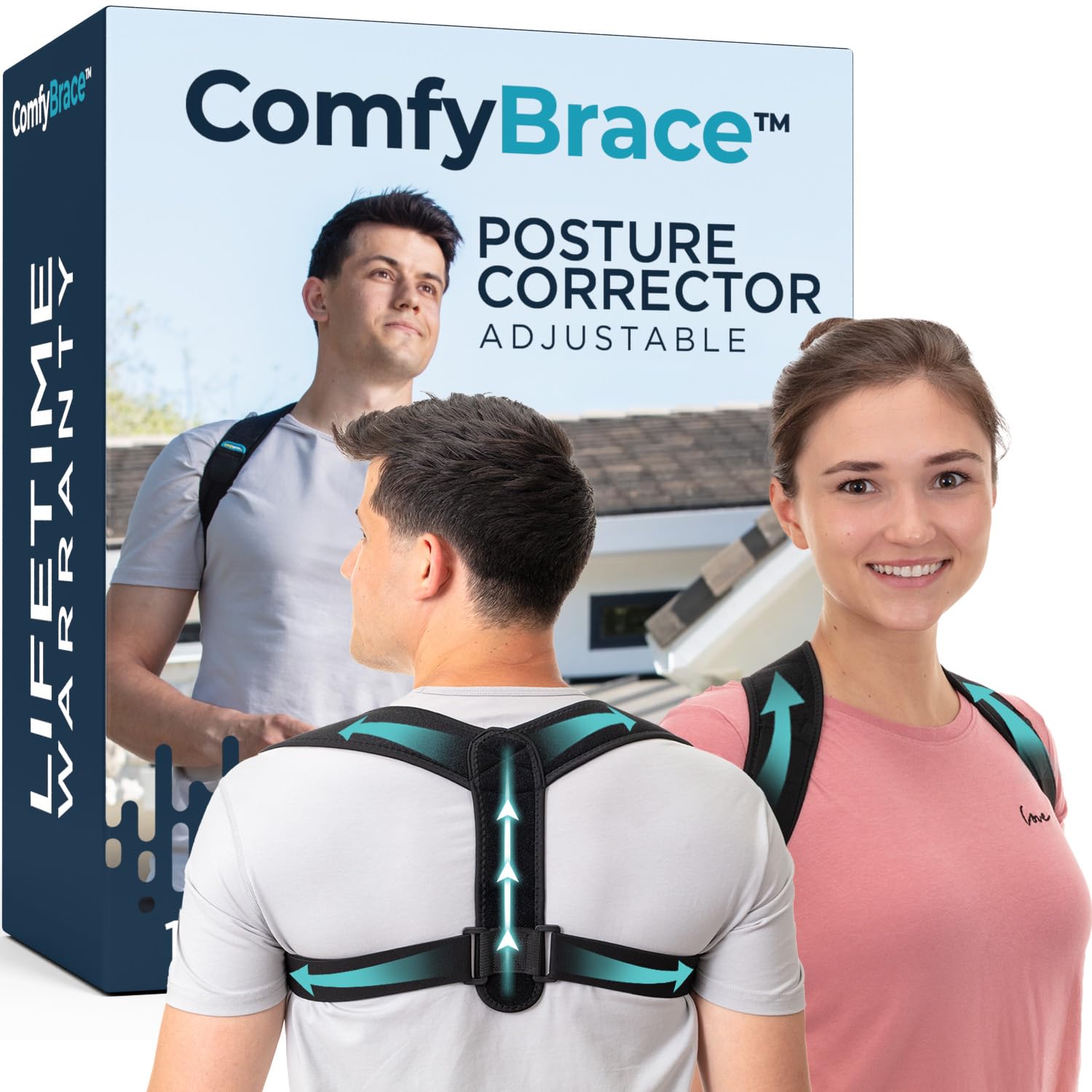
Everyday pick: ComfyBrace Posture Corrector for Men and Women, Back Brace Straightener
 Visit on Amazon →
This is the one I point people toward when they want a first corrector for desk work and they want something they can wear under a shirt without announcing it to the room. The design is the classic over-the-shoulder pull most people picture when they hear "posture corrector," which makes it easy to adjust on your own and easy to shed when your timer goes off.
Wear it for a 30-minute block in the morning and another in the afternoon, over a thin t-shirt for the first week, and treat it as a reminder rather than a support. The habit it builds is the point. The brace is just the alarm clock.
What to watch: any corrector in this style will feel tight under the arms if you crank it. Start with the straps loose enough that you can still take a full breath and slide two fingers under the shoulder straps.
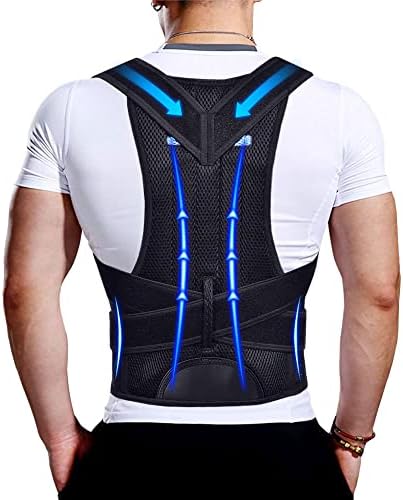
Full-coverage pick: Upgraded Posture Corrector Back Brace for Men and Women, New Version Lumbar Support for Posture Improving and Pain Relief, Full Back Support for Neck, Shoulder, Waist Pain, L
 Visit on Amazon →
This one covers more ground. The name tells you the intent: support that reaches from the upper back down through the lumbar area, cueing the whole chain instead of just the shoulders. That makes it the better choice for someone whose slump starts at the pelvis, the person who sits with a rounded low back and rolled-forward shoulders at the same time.
More coverage also means more contact with your body, so fit matters more here. Get the waistband sitting where you can still hinge at the hip, not so low that it rides up when you stand and not so high that it digs into your ribs when you breathe.
Use it the same way as the other one: timed blocks, never all day, and always off before you train.
How to wear a posture corrector: the step-by-step
Step one: get assessed first if the pain is new, sharp, or radiating. A brace strapped over an undiagnosed nerve issue is a bad idea, no matter how good the reviews are.
Step two: start loose. Snug is not the goal. The straps should remind you, not hold you. If you can feel your ribs being squeezed, loosen them.
Step three: fit it over a thin shirt for the first week. Skin contact plus friction is how people end up with red marks under the arms and a brace in the closet.
Step four: start with 15 to 20 minutes, once a day. Set a timer. The timer is the whole protocol. Fifteen honest minutes beats three vague hours.
Step five: build to 30 to 60 minute blocks, once or twice a day, attached to a specific task. Desk work, driving, the commute home. Do not wear it "around the house" with no end time.
Step six: take it off before exercise. It is not a lifting belt and it is not a running accessory. Your scapular muscles need to work without a crutch pulling them into place.
Step seven: never sleep in it. Overnight is eight hours of compression with no benefit and a real chance of waking up sore.
Step eight: log what you did in the hours you were not wearing it. That log is what decides whether you still need the brace in six weeks.
How long, and how to wean off
The number I give most patients is four to six weeks of timed use, with a taper starting around week three. Cut roughly ten minutes per session per week, and add one strengthening block for every ten minutes you remove. Rows, band pull-aparts, and a thoracic extension over a foam roller cover most of it.
If you are still leaning on the brace at the eight-week mark because your back feels worse without it, that is a signal, not a routine. Get it looked at.
The rolling routine that makes the brace optional
Here is where the foam roller earns its place. A corrector reminds you where your shoulders go. Rolling, plus the strength work that follows, is what makes that position available without a strap.
Roll the upper back, not the low back. Place the roller under the shoulder blades and extend gently over it, letting the thoracic spine move. About two minutes.
Roll the lats. Lie on your side with the roller under your armpit and take slow breaths. This is the tissue that pulls your shoulders forward all day. One to two minutes per side.
Leave the neck alone. No roller on the cervical spine, and no massage gun on the neck either. I have seen the injuries.
Then do the boring part: two sets of rows and two sets of band pull-aparts, three times a week. That is the training that makes the reminder unnecessary.
Mistakes that make a corrector backfire
Wearing it all day. The brace becomes the support and your muscles take the day off.
Cranking it tight because loose feels like it is not working. It is working if you notice it, not if it hurts.
Wearing it during overhead work or lifting. You need full scapular movement for those.
Using it as the only intervention. No brace has ever fixed a strength deficit.
Skipping the taper. If you never wean off, you never find out whether the habit took.
What this all costs
Both of these sit in the affordable end of recovery gear, which is part of why I suggest trying the brace-and-roll combination before you spend anything on bigger equipment. Check current Amazon price on each listing above, since these move around.
The math that matters is not the purchase price. It is the cost per day across the four to six weeks you will actually use it, measured against the cost of another year of the same ache. A brace you wear in timed blocks and then taper off is cheap at any of these prices. A brace you wear for a week and abandon is expensive at any price.
The short version
A posture corrector is a timer with straps. Fit it loose, wear it in short blocks tied to real tasks, take it off before you train, roll your upper back and lats in the hours between, and taper it out on a schedule. Do that and you will not need it in two months. Skip it and you will be shopping for another one in two months.
That is the job. Your back was built to hold itself up. The brace is just there to remind it.